
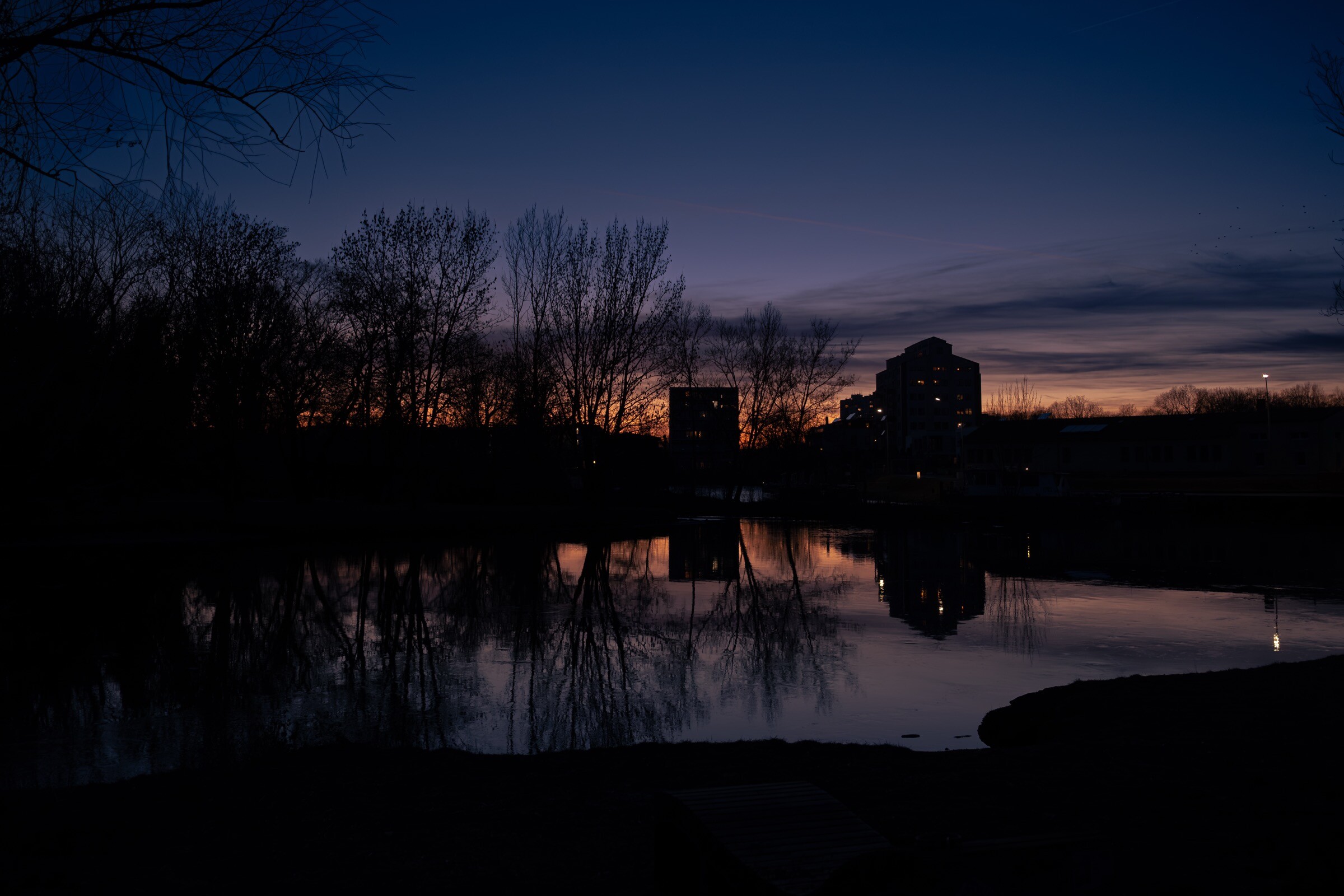
When the sun sets, Halle transforms into an entirely different city. Street lamps bathe facades in warm light, the Saale reflects the bridge lights, and the silhouette of the Marktkirche stands outlined against the deep blue sky. Night photography demands patience, the right equipment, and a solid understanding of light.
The Blue Hour — The Golden Window
The blue hour, roughly 20 to 40 minutes after sunset, is the most valuable period for nighttime city photography. The sky still carries enough residual light for detail, while artificial illumination is already visible. This balance between daylight and artificial light is what makes the blue hour so special.
In Halle, the blue hour begins depending on the season:
- Summer (June/July): approx. 9:30–10:00 PM
- Spring/Autumn: approx. 7:00–7:30 PM
- Winter (December): approx. 4:30–5:00 PM
Equipment for Night Photography
Essential
- Sturdy tripod: With exposure times of several seconds, there is no alternative. I use a carbon tripod with a ball head.
- Remote shutter release or 2-second timer: Prevents camera shake during the exposure.
- Wide-angle lens: Canon RF 15-35mm f/2.8L for architecture and city panoramas.
Recommended
- ND filter: A 6-stop ND filter enables long exposures even during the bright blue hour.
- Flashlight: For focusing in the dark and for light painting.
- Spare batteries: Cold weather significantly reduces battery life.
Camera Settings
For most night shots in Halle, I work in full manual mode:
- ISO 100–400: As low as possible for noise-free results
- Aperture f/8–f/11: Optimal sharpness and attractive starburst effects on light sources
- Shutter speed: 2–30 seconds, depending on the light situation
- White balance: 3500–4000 K for natural-looking night colors, or daylight (5200 K) for a cooler, more dramatic look
- Mirror lock-up or electronic first curtain shutter: Minimizes vibration
The Best Locations in Halle
Burg Giebichenstein
The view from the Saale bridge toward the illuminated castle is one of the city’s most spectacular night vistas. With a long exposure of 15–20 seconds, the Saale’s surface turns silky smooth and reflects the warm glow of the castle lighting.
Market Square and Red Tower
The illuminated Marktkirche and Red Tower form a classic night motif. From the southern market square, both structures can be captured in a single frame. An aperture of f/11 creates distinctive starburst effects on the street lamps.
Saale Bridges
The Giebichenstein Bridge and Kröllwitz Bridge are excellent for long-exposure light trail photography. Passing cars draw luminous lines across the bridge while the Saale below reflects peacefully.
Harbor District
The old harbor quarter offers industrial aesthetics at night — cranes, warehouses, and water surfaces with artificial light reflections.
Creative Techniques
Light Trails
Exposure times of 10–30 seconds transform passing vehicles into glowing lines. Particularly striking at intersections where red taillights and white headlights cross paths.
Starburst Effects
Small apertures (f/14–f/16) create starburst effects on point light sources. The number of rays depends on the aperture blade count of your lens.
Focus Stacking at Night
For maximum sharpness from foreground to background, I create multiple exposures with different focus points and blend them in post-processing.
Night photography in Halle is rewarding in every season. Dress warmly, set up your tripod, and experience the city in an entirely new light.