
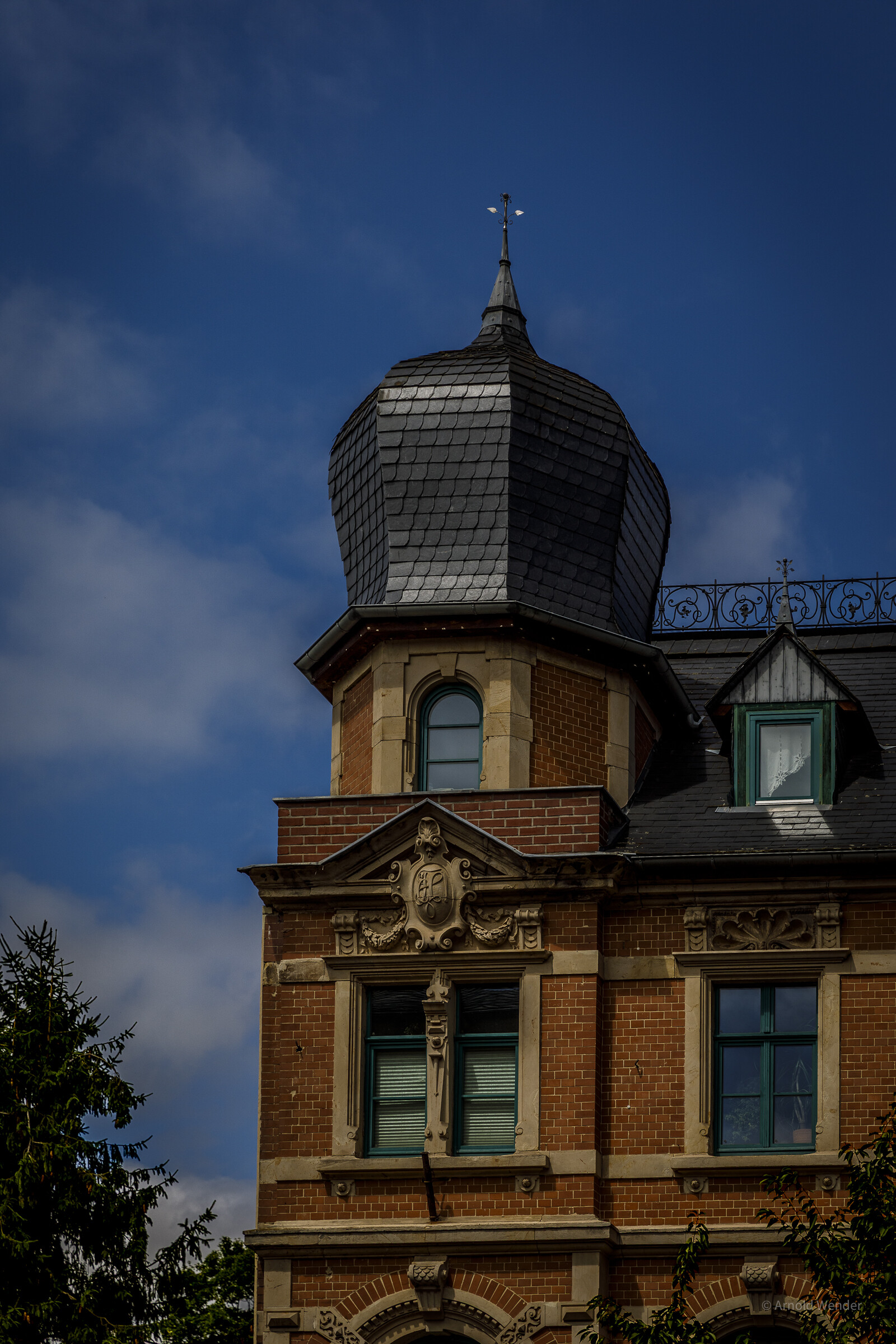
Halle (Saale) is a paradise for architecture photographers. The city unites buildings spanning nearly a millennium — from Romanesque churches and late Gothic hall churches to the ornate Gründerzeit facades that define entire streets. Walk through the city with open eyes, and you will find a subject at every corner.
The Marktkirche — Halle’s Landmark
The Marktkirche Unser Lieben Frauen (Church of Our Lady) with its four towers is the city’s most recognized structure. Photographically, it offers numerous perspectives: a classic view from the market square, a dramatic low-angle shot from Kleine Ulrichstraße, or a composition from the Hallmarkt with the Saale skyline in the background.
For sharp architectural shots, I recommend a tripod and a focal length between 24 and 35 mm. At the Marktkirche, I prefer working with the Canon RF 15-35mm f/2.8L — the wide angle captures the entire facade without excessive distortion. An aperture of f/8 to f/11 delivers the best sharpness across the entire frame.
Moritzburg — Light and Shadow
The Moritzburg, a late Gothic castle complex now serving as an art museum, offers fantastic lighting conditions, especially in winter. The massive walls and the modern extension by Nieto Sobejano Arquitectos create a compelling contrast between old and new.
Best Times of Day
- Morning (7–9 AM): Soft sidelight sculpts the castle walls
- Afternoon (3–5 PM): Warm light on the western facade
- Blue hour: The illuminated courtyard feels particularly atmospheric
Gründerzeit Facades of the Südstadt
The Südstadt district boasts one of the best-preserved Gründerzeit building stocks in Germany. Streets like Beesener Straße, Philipp-Müller-Straße, and Reilstraße showcase magnificent stucco facades with bay windows, balconies, and caryatids.
For facade details, I use the Canon RF 70-200mm f/2.8L. At 135–200 mm, individual ornaments can be isolated without perspective distortion. ISO 100, aperture f/5.6, and a polarizing filter reduces reflections on glass surfaces.
Technical Tips for Architecture Photography
- Avoid converging verticals: Keep the camera as parallel to the facade as possible. Alternatively, use a tilt-shift lens or correct in post-processing.
- Use a polarizing filter: Reduces reflections on window surfaces and enhances the contrast between building and sky.
- Overcast sky as an advantage: Diffused light minimizes harsh shadows and reveals facade details more effectively.
- Seek symmetry: Entrances, stairwells, and courtyards offer natural axes of symmetry.
Hidden Gems in Halle
Beyond the well-known landmarks, the Francke Foundations with their baroque ensemble, the Red Tower on the market square, and the industrial architecture in the harbor district are well worth exploring. Even the prefab apartment blocks of Halle-Neustadt have their photographic appeal — especially as graphic compositions in black and white.
Halle rewards the patient photographer. Take your time, explore the city at different hours, and you will return home with truly unique architectural images.